Figure description
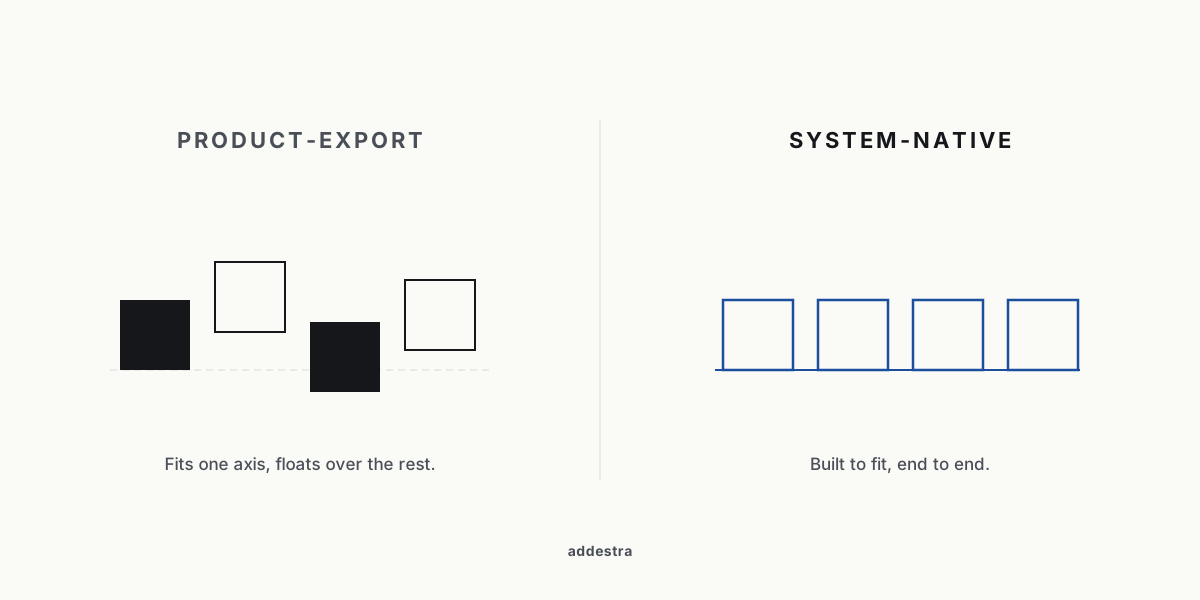
A concept illustration contrasting product-export EdTech — misaligned blocks that meet the system on only one axis — with system-native EdTech, a row of aligned blocks built to fit the whole system.
In 2021, investors put $19.4 billion into education technology. In 2025 they put in roughly $2.4 billion — a decade low, and an 89% fall from the peak (EdWeek Market Brief). The capital didn't leave because the world stopped needing to learn. Southeast Asia alone has around 150 million school-age children and a digital-learning market projected to grow from $10.7 billion in 2024 to $41.5 billion by 2033 (IMARC).
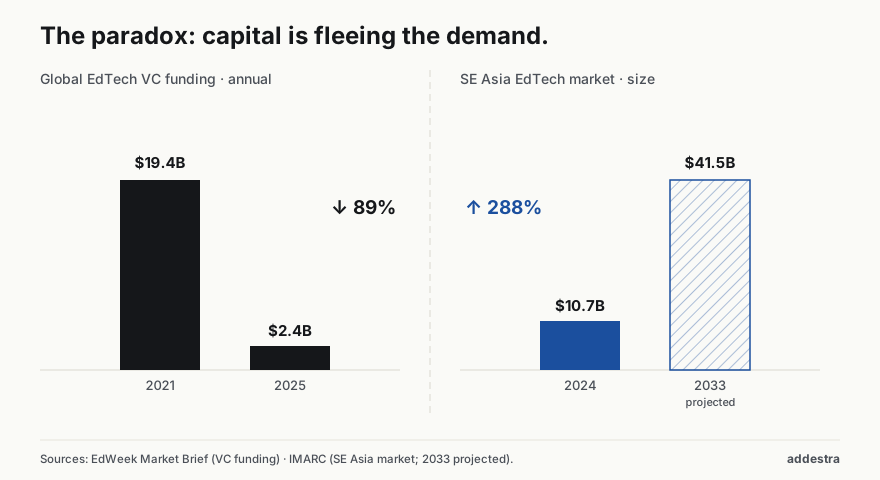
Figure description
Left: global EdTech annual venture funding fell from $19.4 billion in 2021 to about $2.4 billion in 2025 — an 89% decline. Right: the Southeast Asia EdTech market is projected to grow from $10.7 billion in 2024 to $41.5 billion by 2033. Investment is contracting while the regional market expands.
Capital is fleeing precisely where the demand is. That gap is the whole story — and the reason for it is not a market that's too small or students who won't pay. It's that the products built in San Francisco keep failing the students in Penang, Lagos, and Kingston, and the people writing cheques have mistaken a fit problem for a demand problem.
The leapfrog that didn't
For a decade, the pitch was a leapfrog. Western EdTech know-how would vault over a "broken" local system and unlock a market of hundreds of millions of students (Cornell). Byju's was the purest expression of it: a company valued at $22 billion that was going to digitise India's classrooms, then the Middle East's, then Latin America's. It collapsed — not because Indians don't value education, but because the leapfrog assumed away the one thing that actually mattered.
The assumption was that technology could replace a system. It can't. It can only fit one, or fail to.
Product-export vs system-native
Here is the distinction the funding noise misses. There are two ways to build a learning tool for a market that isn't your own.
Product-export takes a tool built for one system — one curriculum, one language, one price point, one infrastructure — and ships it abroad with translated buttons and a regional sales team. System-native starts from the destination system and builds out: the syllabus the student is actually examined on, the languages their classroom actually runs in, the price their family actually pays, the connection their phone actually has.
Product-export looks faster and cheaper to ship. It is also why the graveyard is full. The fit problem has four parts, and a tool has to clear all four. We call them The Four Mismatches.
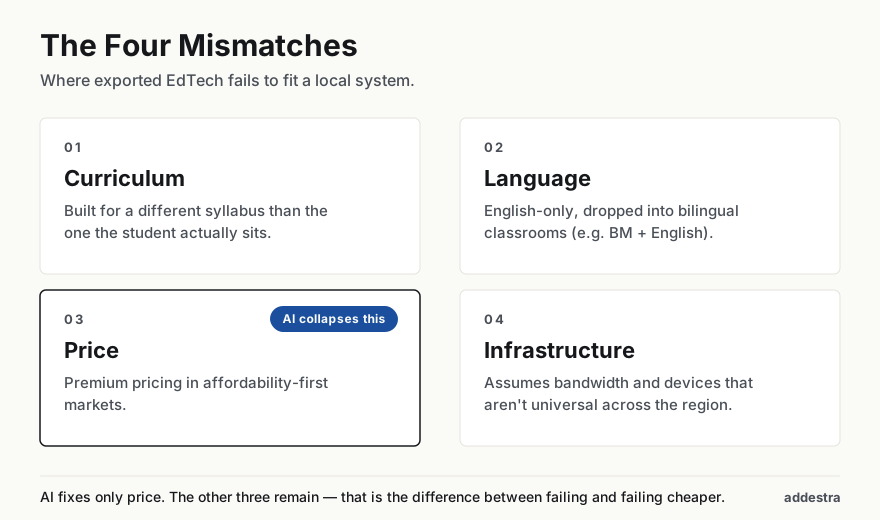
Figure description
Exported EdTech fails on four axes. Curriculum: built for a different syllabus than the one the student sits. Language: English-only versus bilingual classrooms. Price: premium pricing versus affordability-critical markets. Infrastructure: assumes bandwidth and devices that aren't universal. AI collapses only the price axis; the other three remain.
Curriculum. A maths tool built for the Common Core or the English National Curriculum is a tutor for the wrong exam in Kuala Lumpur. Malaysian students sit SPM/KSSM or Cambridge IGCSE; if the tool's worked examples don't map to that syllabus, it teaches confidently in the wrong direction.
Language. Most imported tools are English-only. A Malaysian classroom runs in Bahasa Malaysia and English, side by side — the national Education Blueprint mandates proficiency in both (Malaysia education profile). A monolingual product serves the top slice of the market and silently excludes everyone below it.
Price. Premium pricing alienates the affordability-critical majority. Byju's priced its tiers for aspiration and lost the families it most needed (Cornell). In a market where the mental benchmark for a monthly bill is a streaming subscription, $40-a-month tutoring is not a hard sell — it's a non-event.
Infrastructure. Imported tools assume the bandwidth, devices, and always-on connectivity of a Tier-1 market. Much of the Commonwealth does not have that uniformly. A product that needs a fast, stable connection to function has quietly designed out the students who most need it.
Byju's mismatched on price and curriculum at the same time, then tried to outrun the gap with acquisitions and ad spend. The result was a $22 billion company that ran out of the one resource the leapfrog story assumed it already had: a sustainable fit with the families it was selling to (EdTech Insiders).
What AI actually changes
The economics have genuinely shifted, and it is worth being precise about how. AI tutoring now runs 80–95% cheaper than a human tutor — on the order of $2–5 an hour of equivalent support against $40–100 for a person (Bachu). That is the price mismatch dissolving in real time.
It is just as worth being honest about the ceiling. Bloom's famous "2-sigma" result — that one-to-one tutoring moves a student two standard deviations above a classroom — is the number every pitch deck quotes. The replicated effect across later meta-analyses is closer to one sigma (Education Next). Still real, still large, still capable of changing a life at scale — but one sigma, not magic.
And here is the part the cheap-tutoring excitement skips: lowering the price fixes exactly one of the four mismatches. Drop the cost of a tool that still teaches the wrong syllabus, in the wrong language, on infrastructure the student doesn't have, and all you have built is a way to fail more cheaply.
System-native AI is the opposite move. It generates lessons against the syllabus a student is actually sitting — a lesson generator, not a chatbot that does their homework. It works in Bahasa Malaysia and English. It detects the prerequisite gaps a one-size curriculum left behind. And it degrades gracefully when the connection drops. The same models that let a product-export tool fail cheaply let a system-native tool finally clear all four mismatches at once. The technology is neutral; the design choice is everything.
Why this is a Commonwealth story, not a Malaysian one
What turns a local observation into a thesis is the shared substrate. Cambridge IGCSE is recognised as SPM-equivalent in Malaysia and runs on the same examination spine in Singapore, across much of Africa and the Caribbean, and in the UK itself (Cambridge IGCSE Malaysia). The Commonwealth inherited not just a language but a curriculum architecture — one assessment grammar stretched across dozens of countries.
That is the structural commonality Silicon Valley keeps overlooking, because it doesn't show up on a US total-addressable-market slide. A tool built system-native to the Cambridge substrate is, by construction, built for dozens of markets at once — without a single round of "international expansion." The leapfrog crowd saw a fragmented collection of small markets. The shared substrate says they were one market the whole time.
The Four Mismatches Test
For anyone building, buying, or backing a learning tool for these markets, the diagnostic is four questions:
- Curriculum — does it map to the exam the student actually sits, or to someone else's?
- Language — does it work in the languages of the classroom, or only in English?
- Price — is it priced against a streaming subscription, or against a Tier-1 salary?
- Infrastructure — does it work on the connection and the devices the student actually has?
A tool that fails any one of these is product-export wearing local paint, no matter how good the underlying technology is. A tool that clears all four is system-native — and, in a market the rest of the industry has just abandoned, almost alone.
The capital has left the room. The students have not. The next decade of EdTech in the Commonwealth will be built by whoever stops exporting and starts building from the system out.
Frequently asked questions
Is Western EdTech always wrong for these markets? No. The failure mode is product-export, not Western origin. A tool built from any starting point can be system-native if it clears the four mismatches; most imported tools simply never try to.
Does AI make EdTech profitable again? Not by itself. AI fixes the price mismatch by collapsing the cost of delivery. The companies that turn that into a business are the ones that also fixed curriculum, language, and infrastructure — the cost saving funds the journey, it isn't the destination.
What does "system-native" mean in one sentence? Built from the student's actual system out — their syllabus, their languages, their price point, their connection — rather than shipped in from someone else's and translated.
Sources
- EdWeek Market Brief — "Venture Capital Investment in Global Ed Tech Sinks to Decade Low" (2025): https://marketbrief.edweek.org/financing-investment/venture-capital-investment-in-global-ed-tech-sinks-to-decade-low/2025/02
- IMARC Group — "South East Asia Edtech Market Size, Share, Forecast 2033": https://www.imarcgroup.com/south-east-asia-edtech-market
- Cornell SC Johnson — "What Investors Should Learn from the Fall of Edtech Unicorn Byju's" (2024): https://business.cornell.edu/hub/2024/07/01/what-investors-should-learn-from-fall-edtech-unicorn-byjus/
- EdTech Insiders — "The Edtech Icarus: BYJU's Crashes and Burns": https://edtechinsiders.substack.com/p/the-edtech-icarus-byjus-crashes-and
- Education Next — "Two-Sigma Tutoring: Separating Science Fiction from Science Fact": https://www.educationnext.org/two-sigma-tutoring-separating-science-fiction-from-science-fact/
- UNESCO Education Profiles — "Malaysia: Technology": https://education-profiles.org/eastern-and-south-eastern-asia/malaysia/~technology
- EduSwasta — "Cambridge IGCSE Malaysia 2026: Recognition and Equivalence": https://eduswasta.my/curriculum/cambridge-igcse/
- Bachu — "AI Tutor vs Private Tutor: What's the Real Cost? (2026)": https://heybachu.com/blog/ai-tutor-vs-private-tutor-cost