This is the diagnostic from System-Native EdTech, pulled out so you can use it on a Monday morning. It takes four questions, and a tool has to clear all four — a single failure is enough to tell you it was built for a different system and shipped to yours.
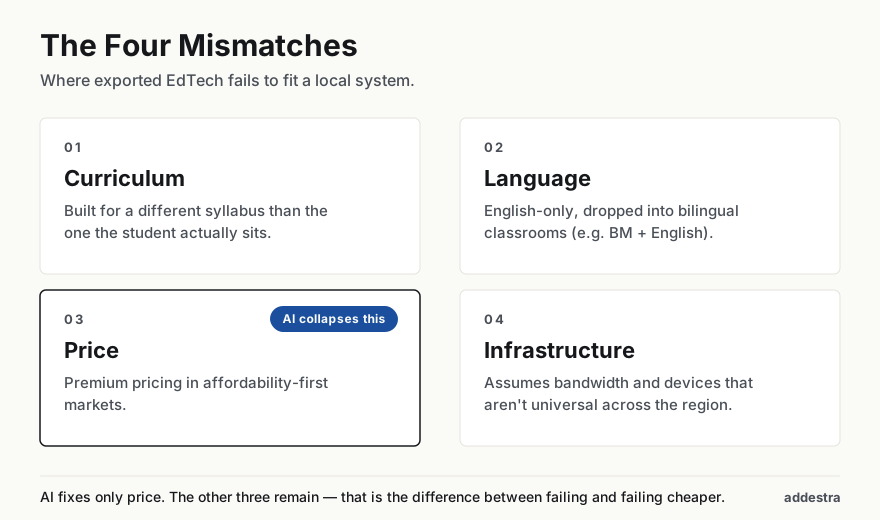
Figure description
Exported EdTech fails on four axes: curriculum (built for a different syllabus), language (English-only vs bilingual classrooms), price (premium vs affordability-critical), and infrastructure (assumes bandwidth and devices that aren't universal). AI collapses only the price axis.
1. Curriculum — does it teach the exam they actually sit?
The question: is the content mapped to the syllabus your students are examined on — SPM/KSSM, Cambridge IGCSE — or to someone else's, like US Common Core or the English National Curriculum?
Why it matters: a maths tool built for a different syllabus teaches confidently in the wrong direction. The topics are sequenced differently, the worked examples are in a different format, and the exam technique it drills is for a paper your student will never sit.
A good answer names your exam board and practises in its format. A bad answer is "standards-aligned" (to US standards) or, more honestly, "we don't yet tailor by country's curriculum."
2. Language — does it work in the languages of the classroom?
The question: does it teach in the languages your students actually learn in — for a Malaysian classroom, Bahasa Melayu and English side by side — or English only?
Why it matters: a monolingual tool serves the top of the market and silently excludes everyone below it. A student who is strong in BM and still building English shouldn't have to fight the language of the tool before they reach the maths.
A good answer is genuine bilingual content. A bad answer is English-first with "more languages coming."
3. Price — is it priced against a streaming subscription, or a Tier-1 salary?
The question: can an ordinary family afford it without thinking about it — streaming-subscription money — or is it priced for a different economy?
Why it matters: this is the one axis AI has already fixed. Good tutoring that cost $40 an hour in a person now costs a few dollars a month in software. A tool that is still priced like a premium import has chosen not to pass that saving on.
A good answer is a free tier plus a low local-currency subscription. A bad answer is Tier-1 pricing translated, not rethought.
4. Infrastructure — does it work on the connection and devices they actually have?
The question: does it run on a phone, on a patchy connection, without assuming always-on broadband and a personal laptop?
Why it matters: much of the Commonwealth is mobile-first and bandwidth-variable. A tool that needs a stable connection to function has quietly designed out the students who most need it.
A good answer is mobile-first and degrades gracefully offline. A bad answer is a desktop-class web app that stalls when the line drops.
The scorecard
| Axis | The question | Passes | Fails |
|---|---|---|---|
| Curriculum | Mapped to the exam they sit? | Native to SPM / IGCSE | "Standards-aligned" to the US |
| Language | Works in their languages? | Bahasa Melayu + English | English-only |
| Price | Priced for the family? | Free tier + local-currency subscription | Tier-1 pricing, translated |
| Infrastructure | Works on their connection? | Mobile-first, offline-tolerant | Always-on broadband assumed |
Four passes is system-native. A single fail is product-export — and worth knowing before, not after, you commit.
How to use it
- Buyers: run it before you standardise a school or a system on a platform. A tool can be genuinely good and still wrong for your students.
- Builders: run it on yourself before you ship. Three of the four are design decisions you make early and can't cheaply reverse.
- Backers: run it before you wire the cheque. A US TAM slide won't show you the four mismatches; this will.
Frequently asked questions
Is one mismatch really a deal-breaker? For your core platform, yes — the gaps compound daily. As a supplement, a tool can fail an axis and still be useful.
Doesn't AI fix all of this? No. AI has collapsed the price axis. Curriculum, language, and infrastructure are still design choices a vendor either makes for your market or doesn't.
Sources
- EdWeek Market Brief — "Venture Capital Investment in Global Ed Tech Sinks to Decade Low": https://marketbrief.edweek.org/financing-investment/venture-capital-investment-in-global-ed-tech-sinks-to-decade-low/2025/02
- UNESCO Education Profiles — "Malaysia: Technology": https://education-profiles.org/eastern-and-south-eastern-asia/malaysia/~technology