Ask a room of parents whether letting a child use AI for homework is a good idea and you'll get a nervous split. The worry is real and it is specific: that a child who can summon a finished answer in three seconds never builds the muscle that produces one. It's a fair fear. It's also, it turns out, answerable — not with an opinion, but with a controlled experiment.
The honest answer: it depends on the tool's job, not the technology
The debate is usually framed as "AI: good or bad for learning?" — which is the wrong question, and unanswerable as posed. A calculator ruins arithmetic practice and is indispensable in a physics exam. The tool isn't good or bad; the use is. The same is true here, and the evidence lets us be precise about which use is which.
The dividing line is simple. A tool can do one of two things when a student is stuck: give the answer, or help the student reach it. The first is an answer-machine. The second is a tutor. They can be built on the exact same model — and they produce opposite results.
The study that settles the "crutch" question
Researchers at the University of Pennsylvania ran a randomised controlled trial with nearly 1,000 students at a Turkish high school, across four 90-minute maths sessions (Bastani et al., PNAS, 2025). Each session had the same shape: a teacher review, a practice period, then an unassisted 30-minute exam with no AI at all.
One group practised with GPT Base — a plain ChatGPT-style interface that answered whatever you asked. A second group practised with GPT Tutor — the same underlying model, but wrapped in guardrails: it was instructed to give teacher-designed hints and walk the student toward the answer, not simply state it. A third group got no AI.
The results are the whole argument:
| Group | During practice (with AI) | On the exam (AI removed) |
|---|---|---|
| GPT Base (unrestricted) | +48% vs no-AI group | −17% vs no-AI group |
| GPT Tutor (guardrailed hints) | +127% vs no-AI group | About the same as no-AI group |
| No AI (control) | — | Baseline |
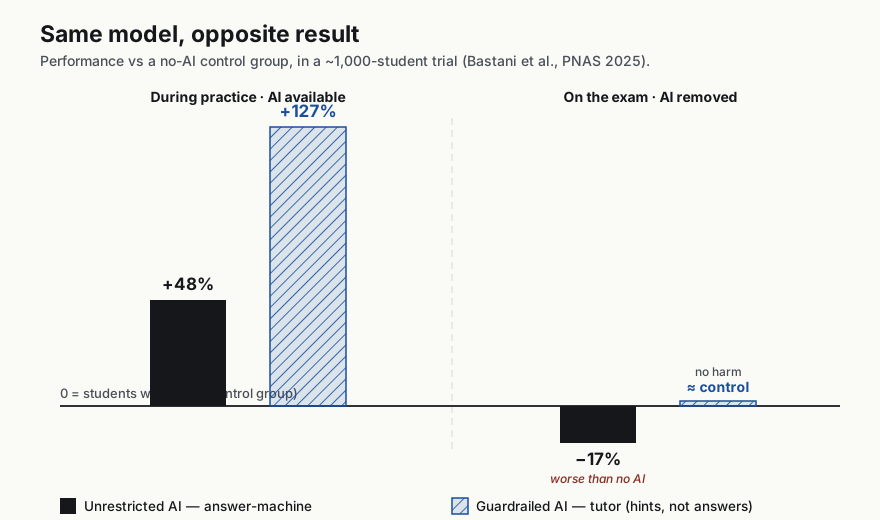
Figure description
Measured against a no-AI control group. During practice with AI available: the unrestricted GPT-4 group scored 48% above control, and the guardrailed GPT Tutor group 127% above control. On the unassisted exam after AI was removed: the unrestricted group fell to 17% below control — worse than never having used AI — while the guardrailed tutor group held roughly level with control, no harm. Same underlying model; the guardrails decided the outcome.
Read the top row slowly, because it is the trap in miniature. During practice, the unrestricted chatbot made students look 48% better. Then the tool was removed for the real test, and those same students scored 17% below the classmates who had never touched it. They hadn't learned less by accident — the chatbot had quietly done the learning for them, and when it left, so did the ability.
The guardrailed tutor is the mirror image. It produced an even bigger practice jump — 127% — because good hints at the right moment genuinely help. But because it made students do the final step themselves, the learning stuck: on the unassisted exam they held level with the control group, with none of the collapse. As the Wharton write-up put it, without guardrails generative AI can harm education; with them, it doesn't (Knowledge at Wharton).
Why the crutch feels like it's working
The most dangerous part of the finding is that the harmful version looks the most successful in the moment. Practice scores go up. Homework gets finished, and finished correctly. A parent glancing over a shoulder sees a confident child producing right answers. Every visible signal says it's working.
It is working — at producing answers. It is not working at producing a student who can find them. The gap only shows up later, in the one place it counts: the room where the tool isn't allowed. That delay is exactly why the crutch is so easy to mistake for a tutor, and why "my kid's marks went up" is not evidence either way until you check what happens when the AI is gone.
Students already know
This isn't only a researcher's worry — the students feel it. In RAND's American Youth Panel, the share of students using AI for homework climbed from 48% to 62% across 2025, driven mostly by middle and high schoolers (RAND, 2026). Over the same stretch, the share who agreed that "the more students use AI for their schoolwork, the more it will harm their critical thinking skills" rose to 67% — up more than ten points in under a year (EdWeek).
More students are using it, and more of them are uneasy about it, at the same time. That isn't a contradiction. It's what it feels like to lean on a crutch you suspect is weakening the leg.
Answer-machine or tutor: how to tell before you commit
You don't need a lab to run the test the study ran. You need one stuck question. Sit with the child, hit a genuinely hard problem, and watch what the tool does.
| Signal | Answer-machine (avoid) | Tutor (look for) |
|---|---|---|
| When the student is stuck | States the final answer | Asks a question back, or gives the next hint |
| Working shown | The solution, ready to copy | The method, one step at a time |
| Who does the last step | The tool | The student |
| After a wrong turn | Silently corrects it | Points at where it went wrong and waits |
| What's left behind | A finished worksheet | A student who could redo it alone |
A tool that fails this — that answers on the first ask — will lift marks this term and hollow them out by exam season. A tool that passes it can be handed to a child with far less worry, because it is built to make them do the part that actually teaches.
Real products already sit on both sides of this line. Khan Academy's Khanmigo, for instance, is deliberately built to guide with Socratic questioning rather than hand over solutions — the living version of the "GPT Tutor" design that did no harm in the trial (see our Khanmigo review). A general-purpose chatbot with no such guardrails is the "GPT Base" design by default. The difference isn't the model behind them. It's the job it's been given.
The catch: "doesn't hurt learning" is not "right for your student"
There's a second question hiding behind the first, and it's easy to miss once you're reassured on safety. A tool can pass the crutch-versus-tutor test perfectly and still be the wrong tool — because it teaches the wrong syllabus, in the wrong language, at a price the family can't carry. Khanmigo is a genuinely excellent, safely-built tutor, and it is still built for the US Common Core, not the exam a student in Kuala Lumpur or Nairobi actually sits.
So the two questions stack. First: does this tool make my student think, or think for them? — the answer-machine test above. Second: is it built for my student's system at all? — which is a different diagnostic entirely, four questions about curriculum, language, price, and infrastructure. We set that one out in The Four Mismatches Test, and the argument behind it in System-Native EdTech. A tool worth adopting has to clear both. Passing one and failing the other is how good marks and wrong fit both slip through.
Frequently asked questions
So should I let my child use AI for homework? Yes, if the tool is a tutor and not an answer-machine — the evidence says a guardrailed, hint-giving tool helps and doesn't cost long-term learning. Run the one-stuck-question test above before you decide, and check what happens to the child's understanding when the tool isn't there.
Isn't the safest option just to ban it? Banning is losing its meaning — 62% of students already use AI for schoolwork, most of them unsupervised. The realistic goal isn't zero use; it's steering the child onto tools that make them do the thinking, and away from the ones that do it for them.
Do the marks going up mean it's working? Not on their own. In the study, the harmful tool produced the bigger short-term gain. The only test that matters is what the student can do when the AI is removed — so look at unaided work, not homework done with the tool open.
Does this apply to every subject, or just maths? The trial was maths, where the "copy the answer" failure is easiest to measure. The mechanism — outsourcing the effort that does the learning — is general. Anywhere a tool can hand over a finished output (an essay, a translation, a summary), the same crutch risk applies.
Sources
- Bastani, H., Bastani, O., Sungu, A., Ge, H., Kabakcı, Ö., & Mariman, R. — "Generative AI Without Guardrails Can Harm Learning: Evidence from High School Mathematics," PNAS (2025): https://www.pnas.org/doi/10.1073/pnas.2422633122
- Knowledge at Wharton — "Without Guardrails, Generative AI Can Harm Education": https://knowledge.wharton.upenn.edu/article/without-guardrails-generative-ai-can-harm-education/
- RAND Corporation — "More Students Use AI for Homework, and More Believe It Harms Critical Thinking: Selected Findings from the American Youth Panel" (2026): https://www.rand.org/pubs/research_reports/RRA4742-1.html
- EdWeek — "Students Are Worried That AI Will Hurt Their Critical Thinking Skills" (March 2026): https://www.edweek.org/technology/students-are-worried-that-ai-will-hurt-their-critical-thinking-skills/2026/03