What JomStudy is
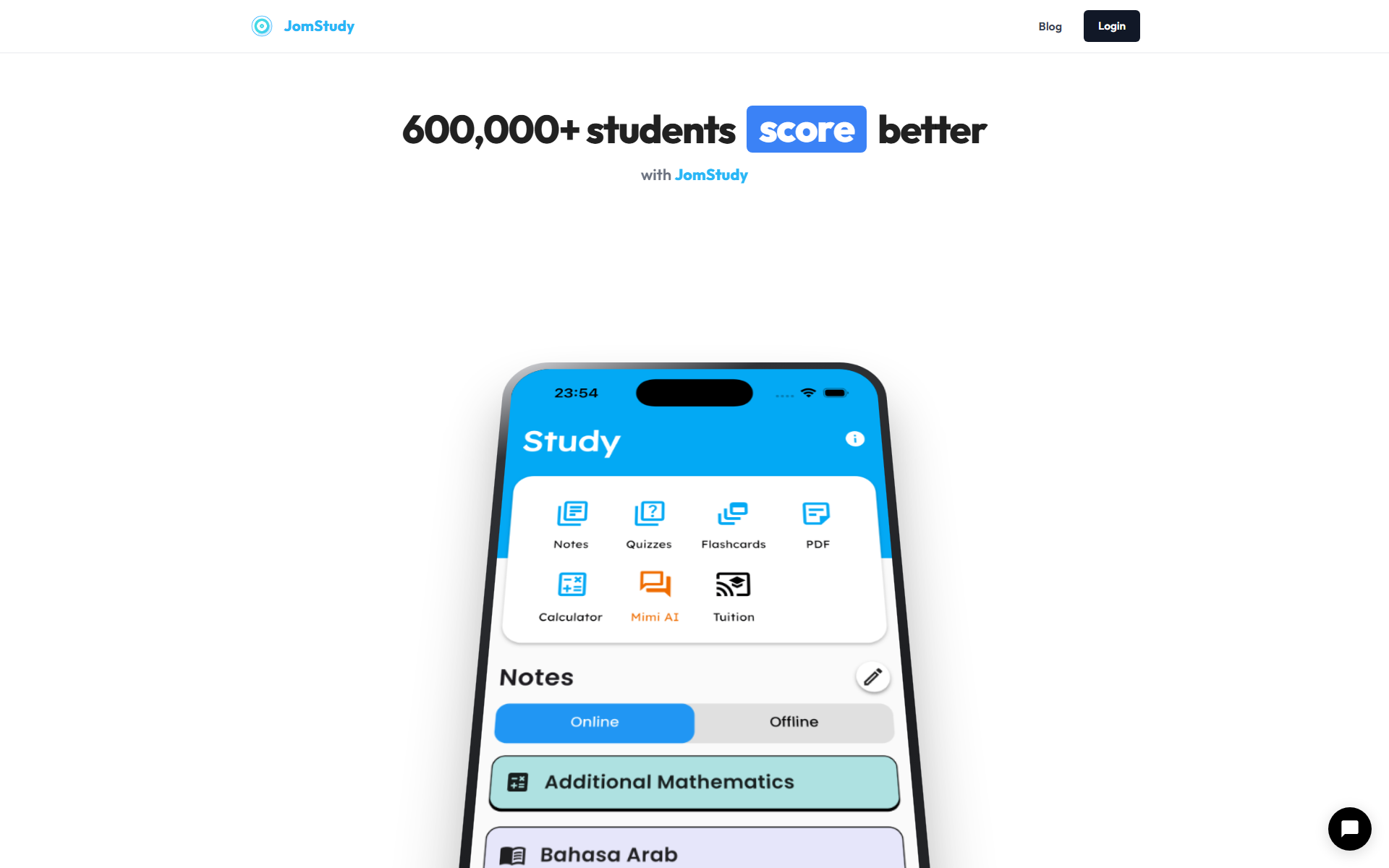
JomStudy is a Malaysian study app for secondary school students, built by Jom Belajar Sdn Bhd. It covers more than 20 subjects across KSSM Form 1–5 — languages (Bahasa Melayu, English, Chinese, Bahasa Arab), sciences, humanities, and business subjects — with revision notes, quizzes, flashcards, a Pomodoro timer, a calculator, and an in-app AI chatbot labelled "Mimi AI" (JomStudy; App Store listing). Its own product screens also show a "Tuition" tab — a paid feature we could not independently confirm the pricing for, so we've left it out of scoring rather than guess.
Free, broad, and system-native is a genuinely good pitch. The question is what "free" turns out to mean once you look at the store listing.
Where it fits: all four mismatches
Run the Four Mismatches Test on JomStudy from a Malaysian buyer's seat, and it clears every axis:
| Mismatch | JomStudy | For a Malaysian buyer |
|---|---|---|
| Curriculum | ✓ Fit | KSSM Form 1–5, 20+ subjects — broader than Tupai (maths-only), on par with Pandai. |
| Language | ✓ Fit | Bahasa Melayu and English, following each subject's KSSM medium of instruction. |
| Price | ✓ Fit | Core content is free with no subject paywall — the strongest "price fit" of any tool we've reviewed, on paper. |
| Infrastructure | ✓ Fit | Android, iOS, or a plain web browser (my.jomstudy.app) — no install required to try it. |
Like Pandai and Tupai, JomStudy is unmistakably built for the Malaysian system, not imported and relabelled. Where it differs from both is the buyer it's chasing: a family that wants to pay nothing at all, not a family choosing between subscriptions.
The part that matters: free content, but a real gamification economy
JomStudy's own homepage is direct about cost: it pitches its notes and quizzes as "fully accessible to every student, for free," with no mention anywhere on the page of in-app purchases. That claim holds up for the part that matters most — the notes, quizzes, flashcards and AI chat are not gated behind a subject-by-subject paywall the way some competitors gate premium content.
But it isn't the whole pricing story. JomStudy's own App Store listing — a different, more detailed official source than the marketing homepage — discloses in-app purchases ranging from $0.99 to $12.99, sold as named passes (Gold, Legend, Diamond, Top Pass, Rahmah Pass) and a currency called "Cat Food," alongside a streak system, leaderboards and avatar customisation. None of that gates the KSSM content itself; it sits on top, in the app's reward loop. But it's a real gap between the "fully accessible... for free" homepage pitch and what the company's own store listing discloses, and it's the kind of thing a parent should know before a child asks to spend on a pass or a currency top-up inside a study app.
We're not marking this down because gamification exists — plenty of good study tools use streaks and rewards to keep students coming back. We're marking it down because the marketing claim and the primary disclosure don't agree, and the gap sits inside a product aimed at school-age children.
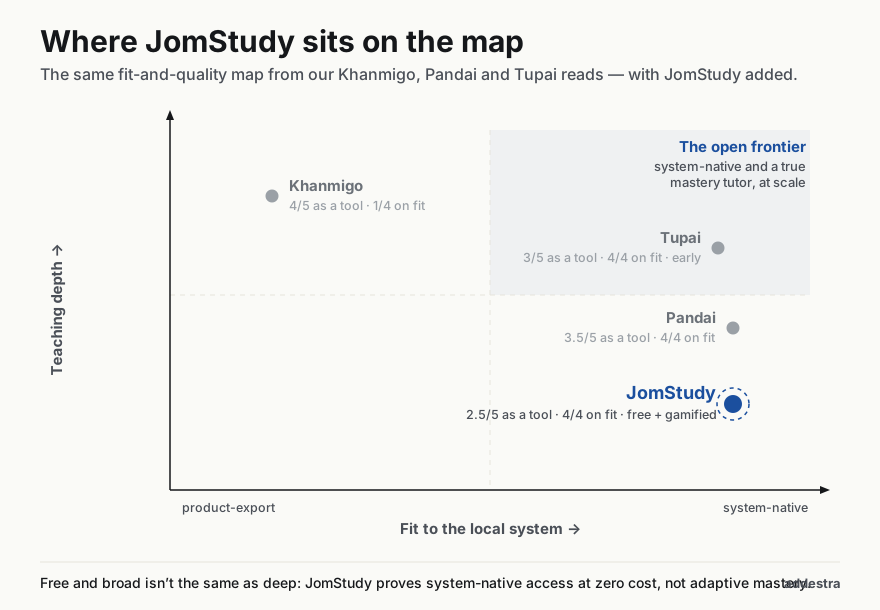
Figure description
On the fit (horizontal) by teaching-depth (vertical) map, Khanmigo is top-left (strong teaching, weak local fit), Tupai is upper-right in the open-frontier zone (system-native, reaching for adaptive depth, but early), and Pandai is bottom-right (strong fit, practice-model depth). JomStudy sits just below Pandai, also bottom-right: system-native fit (4/4) and a practice-and-Q&A model, scored 2.5/5 as a tool. Free and broad puts it in the same fit quadrant as Pandai; it does not reach into the adaptive-mastery frontier any more than Pandai does.
JomStudy vs Pandai — the real choice
Both are Malaysian, both KSSM-aligned, both broad across subjects rather than single-subject like Tupai. Both even claim the same round number — 600,000+ students — on their own homepages. But they're built for different buyers.
- Pandai asks for money upfront and is honest about it: a free tier, then RM30–96/month for premium — a straightforward subscription, backed by a stated 500,000+ explained-question bank and MOE curriculum alignment.
- JomStudy asks for nothing upfront for the actual studying, and makes its revenue instead from an optional gamification layer — passes and currency inside the reward system, not the content — with less supporting detail behind its own scale claim.
If a subscription is a non-issue and you want the more established, better-documented tool, Pandai is the safer default. If a subscription is exactly what you're trying to avoid, JomStudy gets you the content for genuinely nothing — provided you (or your child) can ignore the passes and currency prompts along the way.
Who it's for — and who should look elsewhere
For a Malaysian secondary student who wants broad, free KSSM coverage with no subscription to track, JomStudy delivers on that promise for the content itself. It's a reasonable free-first option, especially for a family that wants to try before committing to anything paid.
Look elsewhere if you need confirmed adaptive tutoring depth rather than a practice-and-Q&A model (Tupai reaches further on that axis, in maths), if you want a tool with independently verified scale or outcomes (JomStudy's numbers are its own, with less supporting detail than Pandai's), or if you'd rather your child not encounter in-app currency and passes at all, even an optional layer — in which case Pandai's plainer subscription model is the cleaner choice.
Frequently asked questions
Is JomStudy actually free? The core content — notes, quizzes, flashcards, AI chat — is free with no subject paywall. Its App Store listing separately shows optional in-app purchases ($0.99–$12.99) for gamification passes and currency, which its own homepage doesn't mention.
Does JomStudy have an AI tutor? It has an in-app AI chatbot, labelled "Mimi AI." We could not confirm whether it guides step-by-step the way Tupai does, so we've scored its teaching depth conservatively rather than assumed it.
JomStudy or Pandai? Different buyers. JomStudy for zero required payment and the broadest free subject coverage; Pandai for a larger, better-documented tool with a plainer subscription model and no in-app currency. See the comparison above.
Is it safe for a young child to use unsupervised? Check the app's privacy settings and in-app purchase controls first. JomStudy's own App Store privacy label discloses usage data that may support ad tracking, and the reward system involves real-money purchases — both worth a parent's attention on a child's device.
Disclosure. Addestra builds learning software, including MathsTutor — a Malaysian, mastery-based maths tutor. JomStudy is not an Addestra product, and its maths coverage is one subject inside a much broader, practice-and-quiz app — a different design to MathsTutor's mastery-only approach. We score our own products nowhere, and we earn nothing from this review. How we choose and how we make money: editorial standards and our review methodology.
Sources
- JomStudy — homepage (student claim, subject list, feature list, operator name): https://jomstudy.app/
- JomStudy — Form 1-5 KSSM App (App Store listing: features, gamification, in-app purchase pricing, developer, privacy label): https://apps.apple.com/us/app/jomstudy-form-1-5-kssm-app/id1511896238
- JomStudy — Form 1-5 Study App (Google Play listing): https://play.google.com/store/apps/details?id=jomstudy.byxun.app